
The best CPQ software for services teams: 6 tools compared
Compare the best CPQ software for services teams. An honest look at six quoting tools, including services-native, deal desk, document, and channel solutions.

Mid-market services companies need a CPQ that matches their quoting complexity without assuming an enterprise operating model around it.
That means services-native quoting and pricing logic, approval flows that work with one or two approvers, CRM-native workflows inside Salesforce and HubSpot, integrations with delivery tools like Kantata, and AI that’s doing the quoting work on day one.

Most services teams evaluating CPQ tools focus on the right variables, at the wrong moment. They compare feature lists, integration depth, reporting dashboards, and pricing. These are all important, but a question that teams should be asking first is: What does this tool assume about the organization running it?
Enterprise CPQs, including the ones purpose-built for services, are usually designed for a team with a CPQ admin, a deal desk, and a revenue operations function. That’s how enterprise services operations are structured, and the platforms reflect it.
Mid-market services teams have the deal complexity that justifies CPQ. Resource-role pricing across seniority levels, multi-phase engagements, discount approvals, margin threshold—the full set.
What they don’t have is the operational scaffolding enterprise CPQ expects to find around it.
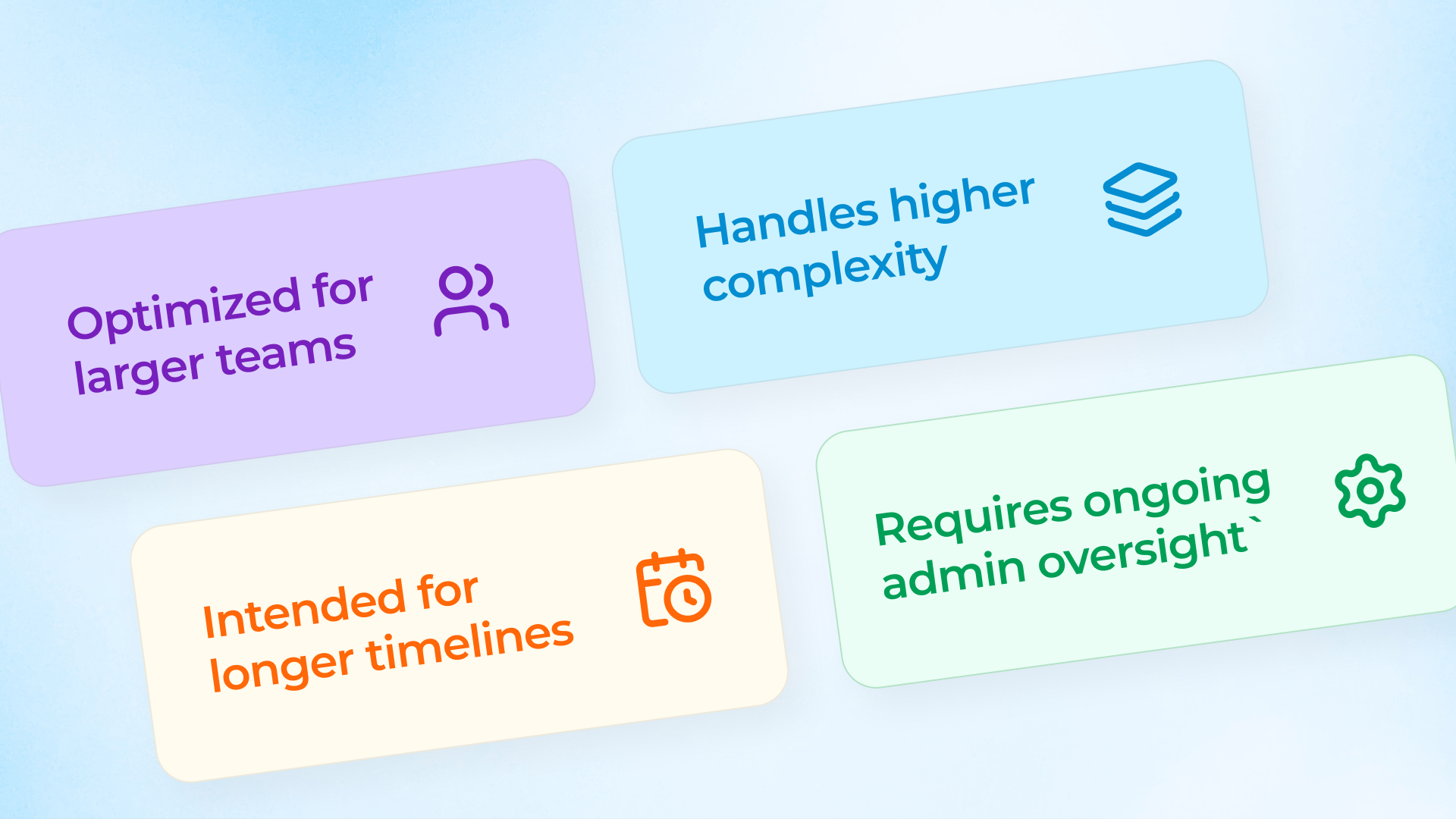
“The problem is that enterprise CPQ, no matter how powerful, is built for a very different environment. One with larger teams, longer timelines, and a higher tolerance for complexity. Mid-market companies, on the other hand, need speed, ease of adoption, and deeper control.”
— Umamaheswaran Manivannan, Product Architect
Enterprise CPQs were designed to handle larger product catalogs, multi-country pricing, deep approval chains, highly customized workflows, and complex ERP and CRM setups.
All of these are powerful tools to have. But they come with tradeoffs—long implementation cycles, heavy consulting support, and ongoing admin ownership.
The overhead-heavy aspect becomes even “heavier” when we compare the speed at which a growing services company moves to that of a typical enterprise.
Some enterprise CPQs also assume someone owns the platform full-time. In mid-market services, ownership falls to a head of ops already running two other functions, or even to an external consultant who bills hourly for every change.
A bigger problem is that a mid-market services team might adjust rates, add new service offerings, and restructure engagement models several times a year, often without a formal release cycle. Enterprise CPQ configuration cycles are built for organizations that plan platform changes more slowly and more structured.
Lastly, enterprise approval logic can route deals through a deal desk, a pricing committee, and a CRO. Mid-market deals route through one or two people who are already knee-deep in three other projects. That’s a friction invisible inside a Fortune 500 company that enterprise CPQ tools are built to serve.
License pricing gets the attention during evaluation. But the real cost is downstream: the implementation partner retained for rollout, the incremental ops time spent on admin work and training, and the quoting cycles that don’t close as fast as they should.
The third one is harder to see and usually the most expensive. When a mid-market services team commits to an enterprise CPQ rollout, the existing quote setup gets replaced months later. During that window, the business is quoting in whatever hybrid state the rollout has reached, which is often slower than the setup it’s supposed to be replacing.
Multiply a two-to-four week slowdown across a year of pipeline, and the implementation cost stops being the line item you negotiated.
When reps avoid the CPQ and build the quote in a spreadsheet or an offline calculator first, then back-enter it to satisfy ops, the standard diagnosis is that the tool is too complex and reps need more training.
The actual mechanism is different. Enterprise CPQ workflows ask for structured inputs that reps in mid-market services teams usually don’t have in the required shape until after the customer conversation is already over. The tool wants the inputs up front, but the sales motion produces them iteratively. Naturally, reps scope the engagement in the conversation, draft the numbers somewhere flexible, and translate them into CPQ later for compliance.
And while training is a common response, it’s not an adequate one.
The design mismatch is the cause, and a few workshops won’t close the gap between how the platform expects deals to be built and how mid-market services teams actually build them.
“If the tool feels too heavy, the users will naturally start working around it, and defeat the purpose of getting the tool in the first place. That’s why mid-market teams should focus on CPQ tools that are fast, intuitive, and flexible. They need enough control to protect pricing and enough speed to close deals within the quarter. That’s it.”
— Umamaheswaran Manivannan, Product Architect
The quote isn’t a price list anymore. Today, it’s a commercial plan combining recurring and one-time components, milestone-based delivery, fixed-fee phases layered with T&M components, and outcome-based pricing that resists traditional line-item structures.
Some services companies offer subscriptions and services, some have productized their services, and some offer managed services. This complexity requires higher levels of flexibility, control, collaboration inside the CRM, AI-assisted workflows, and full margin visibility.
While some services-native enterprise CPQ options can deliver on all of the above, the configuration overhead remains an issue, especially knowing that mid-market teams now expect software to reduce work immediately, not after a long setup.
They expect an AI-assisted tool that generates quotes from simple inputs, recommends pricing and structure, speeds up approvals, and reduces manual data entry.
A shortlist that cuts through most vendor presentations:
We built Provus AI for services organizations with the scale, process maturity, and operational infrastructure to run an enterprise platform well. But along the way, we kept meeting teams that had the quoting complexity to justify CPQ without the scaffolding around it.
CPQ Express is what we built for them.
Services-native logic without the enterprise operating model assumption. Self-serve setup, AI quoting from day one, out-of-the-box integrations, approval flows designed for the org chart your team actually has. Most importantly, full margin visibility and control.
Start a free trial or book a demo to see what CPQ looks like when the platform is actually built for how you operate, price, and quote.


Services Quoting for Professional Services

Services Quoting for Consulting Services

Services Quoting for Asset-Based Services
Compare the best CPQ software for services teams. An honest look at six quoting tools, including services-native, deal desk, document, and channel solutions.

See what’s new in Provus AI, including agents that turn emails into quotes, price on value, and optimize live deals. Watch the replay for the full demo.

WWT’s Global PMO on how to build a feedback loop between sales and delivery, and where AI fits. Watch the replay.