
The best CPQ software for services teams: 6 tools compared
Compare the best CPQ software for services teams. An honest look at six quoting tools, including services-native, deal desk, document, and channel solutions.

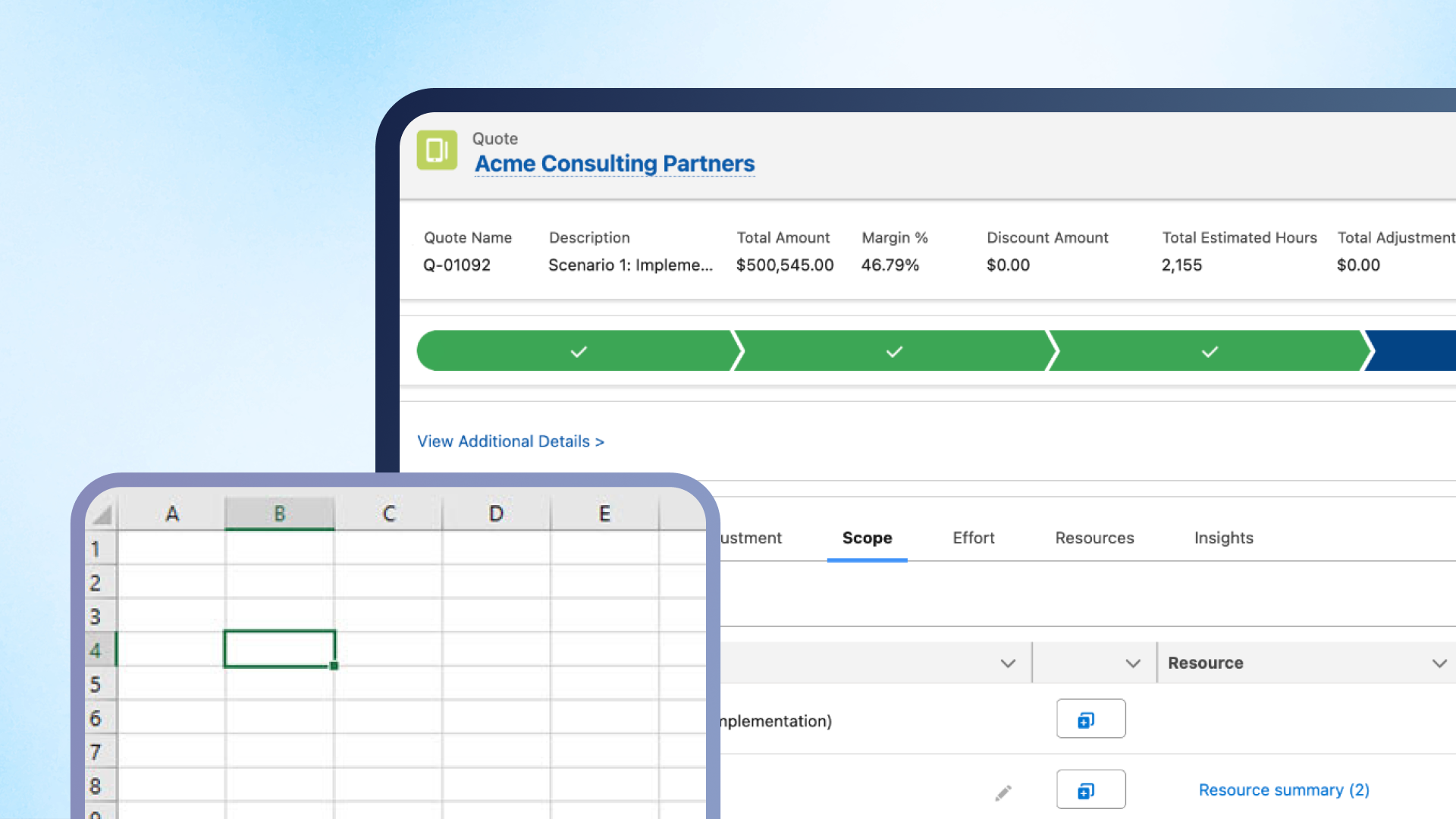
Services companies move away from spreadsheet-based quoting when the operational cost of maintaining it exceeds the effort of replacing it. That threshold is a pattern of compounding gaps: inconsistent pricing across reps, margins that can’t be validated before a contract goes out, no connection between what’s quoted and what can be delivered, and a quoting cycle that depends entirely on a few people who “own” the pricing logic.

Quoting a services engagement is a calculation across interdependent variables—resource seniority, rate cards, phase durations, discount structures that need approval, and add-on services that change the margin profile of the entire deal.
A spreadsheet can hold all of those numbers. What it can’t do is enforce the relationships between them.
Change the seniority mix on phase two, and the margin impact cascades across the engagement. Add an extra week to a project timeline, and the cost structure shifts underneath. Apply a discount at a phase level, and someone needs to manually check whether the deal still meets the target margin at the quote level.
In a spreadsheet, those cascading recalculations are all manual, which means they’re inconsistent, slow, and dependent on whoever built the formulas. In a structured quoting system, they’re automatic. And that difference costs you more and more, the more deals enter your pipeline.
“By the time most quotes reach the client, the team has lost days on the process and still can’t tell you whether the deal is underpriced or overpromised. That’s the part that should concern you more than the slow turnaround.”
— Nikhil Tayal, VP & Site Lead
When pricing decisions happen inside disconnected files, there’s no mechanism to validate a deal’s profitability before it goes out. This way, you risk layering discounts without a total-margin view or having your rates drift from the approved card. You also risk having two sales reps quote the same scope at materially different prices, and no one catching it because there’s nothing to catch against.
A services quote built in a spreadsheet means there’s no shared view of what’s been quoted, at what price, or at what margin. When a second rep quotes a similar engagement the following month, they’re starting from scratch, without reference points or ways to know whether their numbers align with what was quoted the last time. The result is a portfolio of deals priced independently, with no connection between them.
This is an often-overlooked business risk. In many growing services firms, rate logic, discount thresholds, and margin targets live inside one person’s memory. And when every deal routes through that person for pricing validation, you’ve created a dangerous dependency that limits how many deals can run in parallel and how fast a single deal can move. You’re also inviting a bigger issue, in case that person decides to move companies.
Every quote built in a spreadsheet is a standalone event. You have no way to see your quoting activity as a connected picture. How many deals are in progress? What’s the total pipeline value? Which quotes have been sitting in draft for two weeks? These are basic operational questions that spreadsheets can’t answer without someone manually compiling the data, which usually means they don’t get answered at all.
Version control, manual formatting, approval-by-email, and CRM re-entry are far more than annoyances. They’re the reason why a quote that should take hours takes weeks. They’re also a competitive risk in any deal where timing signals seriousness, or where the prospect simply doesn’t want to waste weeks waiting for a quote they’re uncertain about.
This fix is replacing the spreadsheet workflow with a tool that’s purpose-built for the way growing services teams sell and operate.
That’s why we built CPQ Express around the native structure of services quoting—resource roles, billing rates, project phases, and add-on services. With our tool, your catalog, rate card, and margin thresholds are inside the system, not inside someone’s head or a formula they built two years ago.
The CPQ Express difference is best seen in how quotes are created. Describe a project in plain language, and the built-in AI assistant maps it to your existing services catalog, complete with suggested resources, phases, and pricing. You just review, fine-tune if needed, and share.
What used to take days of back-and-forth now takes minutes of focused decision-making.
Margin visibility moves from being after-the-fact to built-in. Every quote shows its margin profile before it leaves the building, and you’re no longer discovering profitability gaps at delivery kickoff.
A centralized dashboard tracks pipeline value, draft quotes, and deal status across your team, replacing the scattered files and inbox threads that made it impossible to see your quoting activity in one place.
And because CPQ Express connects directly to your CRM, the quote-to-close loop tightens. No more manual re-entry, no more version confusion, no more deals stalling because someone forgot to update a field.
“The teams we built CPQ Express for were never looking for a complex enterprise platform. They wanted a tool that gives them quoting structure and margin visibility without slowing them down. That’s the gap, too much process overhead on one side, too little pricing control on the other.”
— Nikhil Tayal, VP & Site Lead
No one chose spreadsheets because they were lazy. They chose them because spreadsheets were available and good enough for the volume and complexity at the time.
The signal that you moved past that stage is the accumulation of every gap described above. Margins you can’t validate. Pricing locked in one person’s memory. Quotes that take weeks when they should take hours. A quoting process that worked when the founder ran every deal, but can’t support a growing team.
CPQ Express is a lightweight quoting platform with fast setup, AI-assisted quoting, and built-in margin controls, helping your team go from project scope to accurate, margin-aware quotes in minutes, without implementation overhead.
Try Provus CPQ Express for free or book a demo to have us walk you through it.


Services Quoting for Professional Services

Services Quoting for Consulting Services

Services Quoting for Asset-Based Services
Compare the best CPQ software for services teams. An honest look at six quoting tools, including services-native, deal desk, document, and channel solutions.

See what’s new in Provus AI, including agents that turn emails into quotes, price on value, and optimize live deals. Watch the replay for the full demo.

WWT’s Global PMO on how to build a feedback loop between sales and delivery, and where AI fits. Watch the replay.