
The best CPQ software for services teams: 6 tools compared
Compare the best CPQ software for services teams. An honest look at six quoting tools, including services-native, deal desk, document, and channel solutions.

An AI-powered GTM strategy for services companies means applying AI strategically across the full GTM motion, with the right foundations at each stage first. AI acts as a multiplier on whatever process is already underneath it. If it’s structured and consistent, AI compounds the advantage. If it’s unstructured and ad hoc, AI scales the inconsistency.

Most services companies are making the same move: they’re trying to “add AI” to their GTM motion. Rolling out copilots, automating outreach, and generating proposals faster.
On paper, it looks like progress. In practice, the results are uneven. More activity, more output, but often no meaningful shift in win rates, deal quality, or margins.
The issue is a lack of clarity about where and how to apply AI tools, and what problems they should address. Sales pursues poorly qualified deals. Marketing optimizes for volume over precision. Customer success reacts instead of predicts. Layer AI on top of that, and you get faster dysfunction.
At Provus, we see this most clearly in services organizations running complex deals, where quoting, pricing, and deal structuring often still happen across spreadsheets and layered approval chains. AI is being applied mostly to pipeline generation, while the process that converts the pipeline into profitable revenue often stays untouched.
“AI will help you target the wrong customers more efficiently. It will help you scale weak messaging. It will give you better visibility into a pipeline that still isn’t working. It will accelerate you in the wrong direction.”
— Stawan Kadepurkar, Founder and CEO
Pipeline gets attention. Targeting, messaging, lead generation—the assumption is that GTM performance is won or lost at the top of the funnel.
But the pipeline only creates potential. Outcomes are usually decided later, when a deal is actually built. How it’s priced, how scope evolves during negotiation, how discounts creep in, and whether anyone pressure-tests the margin impact before the contract goes out.
This is the layer where revenue takes shape. In many services organizations, it’s also the least structured part of the entire GTM motion.
In a product sale, pricing is relatively fixed. In services, a single engagement bundles resource seniority, timelines, delivery assumptions, and margin risk into one commercial decision. Swap the project phasing or replace a senior with a mid-level consultant, and you can lose control of profitability fast.
This complexity is exactly where generic AI tools fall short.
A faster quote built on flawed assumptions is still a flawed quote. An automated proposal that ignores the relationship between scope and delivery capacity will unravel once the project begins, regardless of how polished it looked when it went out.
Yet many services teams that apply AI to quoting do it without a structured quoting system.
Their AI doesn’t understand the pricing logic—because that logic lives in individuals’ heads. Scope adjustments are executed without guardrails, creating problems down the road. And delivery still finds out how a deal was structured after it’s signed.
AI only works if you know what you’re optimizing for and why. Without clarity and structure underneath, AI just helps you make the same mistakes you’re making right now, only faster.
Instead of applying AI to surface-level GTM tasks, Provus deploys agentic AI directly inside the quoting process.
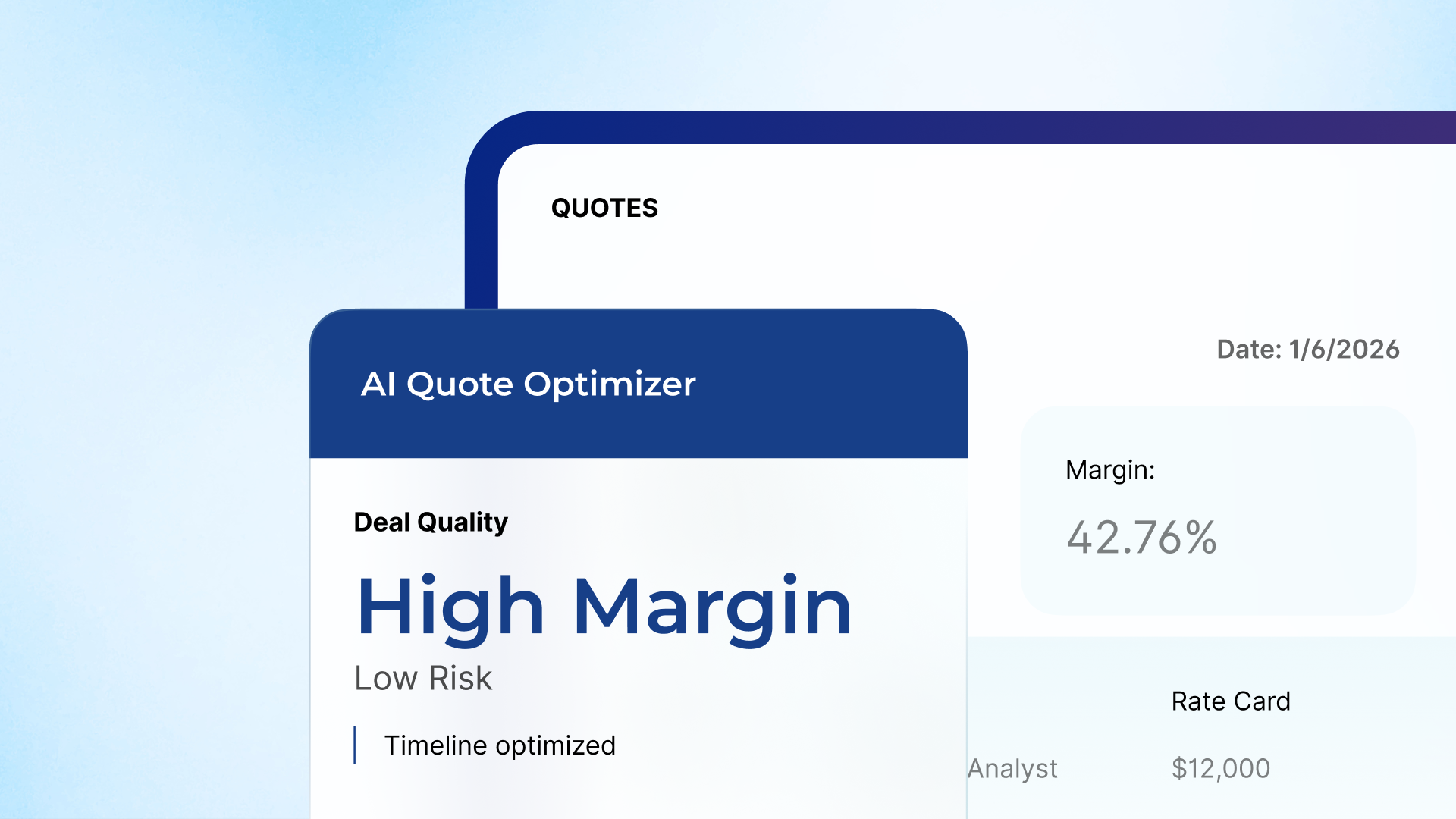
It has five purpose-built AI agents that flag deal risks, optimize pricing against margin targets, forecast win probability based on historical patterns, generate structured quotes from sales calls and RFPs, and identify at-risk deals before they close at wrong terms.
When you apply AI while the deal is being built, you can model different scenarios against margin targets and make the tradeoffs visible before anyone commits. When scope or other details change during negotiations, the commercial implications surface immediately, connected to what delivery can actually deliver.
At Provus, we don’t think AI should replace human judgment. But it should augment it. The goal is to give teams more speed, but also better data at the moment they’re making decisions that shape revenue and margin.
“GTM has historically been human-driven and hard to scale. And so, there is a strong push to try to automate everything. But that’s a mistake. What we see is that the best teams are using AI to surface insights faster, identify opportunities earlier, and connect data back to GTM decisions.”
— Stawan Kadepurkar, Founder and CEO
When AI is applied strategically, it enables a fundamental shift in how services organizations run their go-to-market.
Static GTM relies on fixed playbooks. Adaptive GTM builds systems that learn. Dynamic prioritization instead of static scoring. Context-aware quoting instead of generic templates. Continuous optimization instead of periodic planning.
Each deal that moves through a structured quoting process generates intelligence that sharpens the next one, with pricing benchmarks getting tighter, win probability more accurate, and alignment between what’s sold and what’s delivered improved.
The teams getting real value from AI have something in common: they started with the problem, instead of the technology.
They didn’t begin with “we need AI in our sales process because everybody’s doing it”. They began with “we need to know whether this deal is profitable before we sign it” and “we need to see the margin implications of a scope change before it’s locked in”.
They asked:
That discipline—defining the problem, building the structure, then applying AI—is what separates a GTM engine that supports growth from the one that just runs faster in circles.
Book a demo to see how Provus applies agentic AI to optimize pricing, flag deal risks, and protect your margins inside the quoting process, before the contract goes out.


Services Quoting for Professional Services

Services Quoting for Consulting Services

Services Quoting for Asset-Based Services
Compare the best CPQ software for services teams. An honest look at six quoting tools, including services-native, deal desk, document, and channel solutions.

See what’s new in Provus AI, including agents that turn emails into quotes, price on value, and optimize live deals. Watch the replay for the full demo.
WWT’s Global PMO on how to build a feedback loop between sales and delivery, and where AI fits. Watch the replay.