

AI Sales Transformation Lessons from Thoughtworks
The real work behind overhauling a global professional services sales org
For technology consulting firms, AI sales transformation isn’t a switch you flip. It’s a multi-year journey that starts with data infrastructure, runs through cultural change, and only then reaches the tools. But what does that actually look like inside a firm operating across 19 countries, with decades of reputation-driven growth suddenly no longer enough?
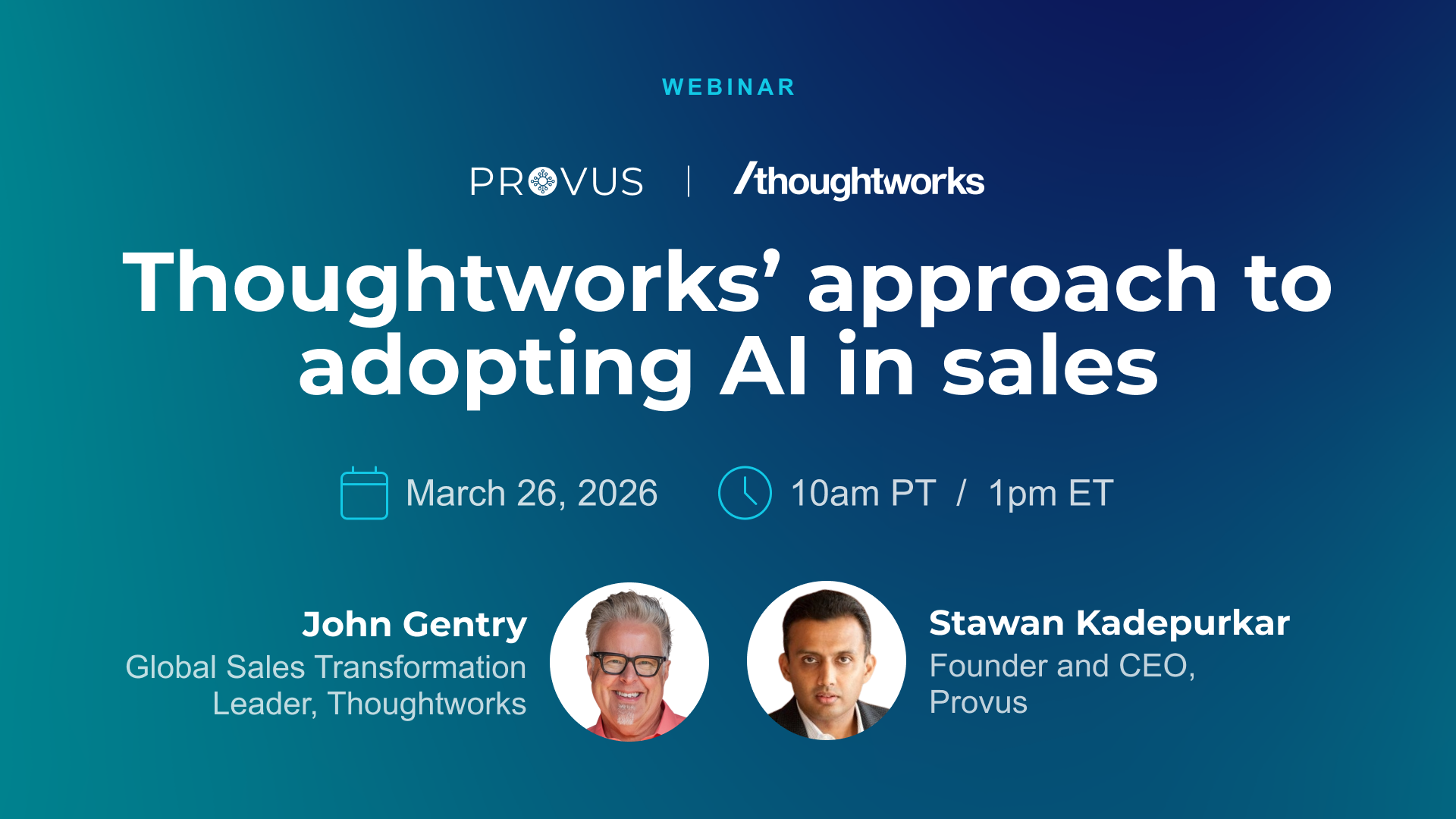
That’s the story John Gentry, former Global Sales Transformation Leader at Thoughtworks, told in a recent webinar with Provus. Whether you’re a CRO, VP of Sales, or RevOps leader navigating how to bring AI into your sales motion, this is one of the most detailed, honest accounts of professional services sales modernization you’ll find.
Catch a summary below, and watch the full Thoughtworks webinar replay here.
Why Thoughtworks needed a sales transformation
As a global leader in technology consulting, Thoughtworks spent 30 years growing largely on reputation and word of mouth. Their technical credibility—some team members even signed the Agile Manifesto—kept the phone ringing. But when post-COVID budget contractions slowed inbound demand, the company found itself without a proactive growth engine to fall back on.
“We had a really strong team that could take in demand, qualify it, get to closure, get the teams going, get the project started and finished. But when we had to turn it loose on the marketplace at scale, that was kind of our issue.” — John Gentry
Compounding the challenge was that Thoughtworks had grown into 19 different countries, each with its own go-to-market approach. The result was an organization operating more like 19 separate companies than one unified global professional services firm. And clients felt the inconsistency.
How Thoughtworks laid the data foundation for AI
Rather than immediately overhauling systems, John spent his first three months conducting interviews with 200 to 300 leaders across the business—spanning sales, finance, legal, delivery, and beyond—to understand what problems people actually felt, what had been tried before, and where momentum already existed.
From those conversations, he developed a clear North Star: build a culture of growth, transparency, collaboration, and accountability. Everything that followed was anchored to those principles.
One of the most significant early discoveries was the state of Thoughtworks’ data. Despite having a CRM, it wasn’t used consistently—and there was no shared language across regions, not even for basic concepts like what a “qualified deal” means.
“We didn’t really have a cadence in place that was a global cadence.” — John Gentry
The foundational work came first. Standardize sales stages, enforce CRM usage, and establish a consistent forecasting rhythm—weekly at the market level, monthly at regional and global levels. Not glamorous work, but the prerequisite for everything else.
Fixing the deal approval process—and getting pricing online
Once the data foundation was in place, the team turned to execution. One of the most frustrating pain points for sellers was a broken deal approval process. Deals often fell apart at the last minute due to internal misalignment.
“It was very, very hard to get a deal approved. Oftentimes, you’d try to get a deal approved, and you’d find out half an hour before you hit the send button to the client, that there’s somebody in the company that doesn’t like it. They pulled the brakes on the deal at the last moment. There were lots of issues like that.” — John Gentry
Thoughtworks addressed this by implementing a formalized deal coaching structure. Rather than putting sellers on trial in front of management, coaches were assigned to guide deals internally—clearing roadblocks proactively and building alignment before approval was required.
Equally important was getting pricing and quoting out of spreadsheets and into an enterprise system.
“We discovered that we didn’t really know where we were with pricing.” — John Gentry
Thoughtworks had built sophisticated Excel-based tools, but lacked the ability to track pricing trends or make data-driven quoting decisions at scale. That’s where Provus came in—bringing service-specific pricing intelligence into the sales process and giving the organization visibility it had never had before.
Thoughtworks’ two-wave approach to AI in professional services sales
With the data foundation in place, Thoughtworks began exploring how AI could accelerate and elevate its sales efforts—including transitioning to value-based pricing using agentic systems. John and his team adopted AI in two distinct waves.
Wave 1: Speed
The first wave was about doing existing work faster. Thoughtworks indexed sales collateral across Google Drive to eliminate the “dark web” of un-indexed institutional knowledge—helping teams find and assemble proposals from existing materials. Work that once took days was compressed dramatically.
But John was clear about the first wave’s limits.
“I didn’t think we were losing deals because our proposals weren’t getting done fast enough. I said, ‘We should either get them done better and avoid the proposal process altogether by entering early with a value proposition that’s non-competitive. I’d rather use AI for that, and that gets me to the next wave.’” — John Gentry
Wave 2: Intelligence
The second, more strategic wave focused on understanding clients more deeply: using agentic AI tools to conduct deep account research, surface the issues most important to each client, and build account plans grounded in real data rather than guesswork. This is where value-based pricing and consultative selling began to converge—with AI generating the client intelligence that made both possible.
The team also grappled with tool sprawl. Their solution was to build a unified front-end chat drawing from multiple AI sources (ChatGPT, Claude, Perplexity, and others) within secure, agreed-upon confidentiality frameworks—so sellers could focus on the work, not on managing which tool was doing what.
4 AI sales strategy lessons for CROs and RevOps leaders
- Get your data right first. If pipeline data isn’t being refreshed consistently, AI won’t fix it. It will hallucinate on top of bad inputs. Data hygiene dashboards and accountability structures are non-negotiable.
- Let seller pain points drive AI investment. Find the real blockers in your sales process and solve those first, rather than chasing tools for their own sake.
- Think strategically, not just tactically. Using AI to do existing tasks faster is valuable, but the real advantage comes from using it to understand clients more deeply, pursue better-fit opportunities, and build more consultative relationships.
- Develop personal AI fluency. “If you’re not really fully personally understanding the relevance of AI’s capabilities, you’re going to be two steps behind all the time,” John said. For leaders, hands-on experimentation is foundational.
AI as a unifying force across sales and delivery
Both John and Stawan agreed: we’re living through a shift comparable to (potentially larger than) the rise of the internet. Just as businesses first put brochures online before discovering what the internet could truly do, organizations today are only scratching the surface of what AI makes possible.
Companies that win won’t be the fastest-moving ones. They’ll build the right foundation, invest in genuinely understanding their clients, and use AI to create alignment across departments—sales, marketing, delivery, and strategy—rather than just speed.
“AI should be unifying. It should lead to greater understanding.” — John Gentry
Still chasing deal approvals at the last minute? Book a demo to see how Provus gives services teams the pricing infrastructure and AI quoting they need to sell smarter.