
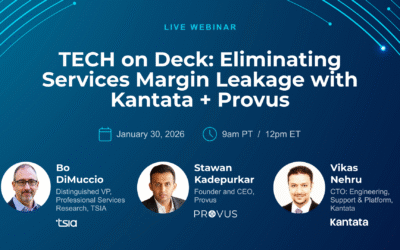
How Kantata & Provus Eliminate Services Margin Leakage (TSIA TECH on Deck)
For service organizations, it’s crucial to eliminate margin leakage and streamline processes for real-time operational clarity.

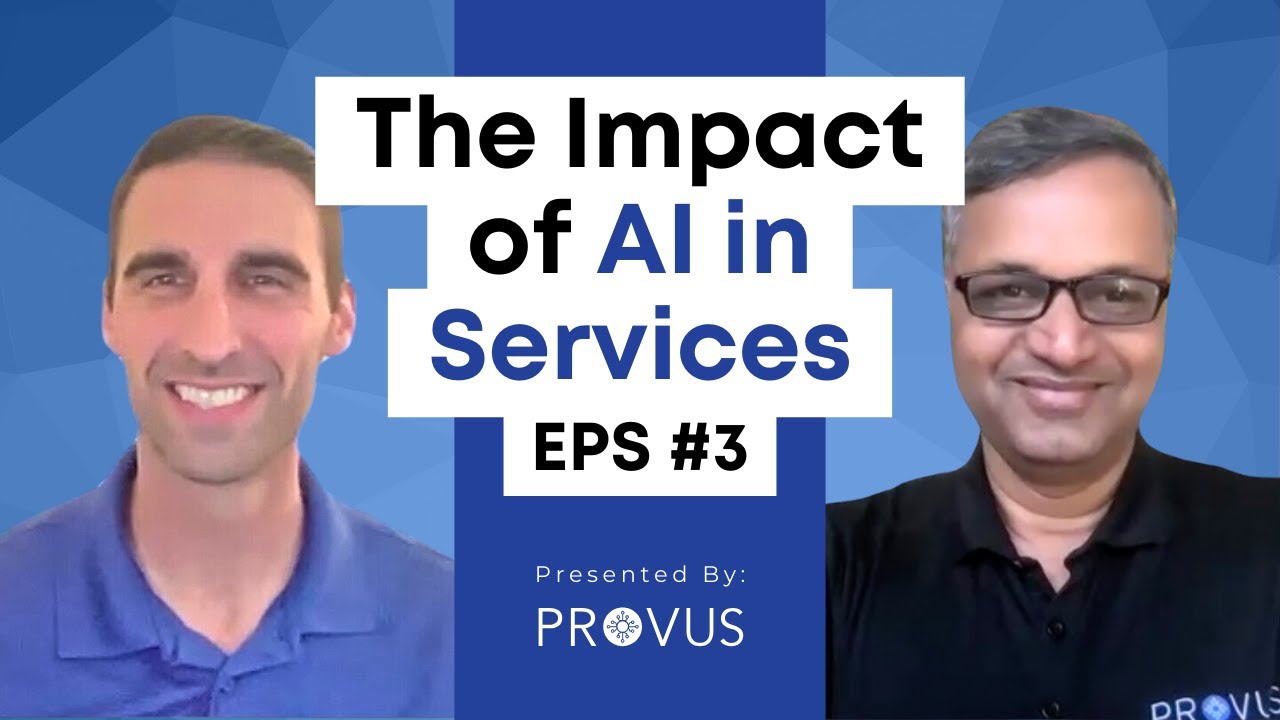
AI isn’t coming to Services Ops. It’s already here. It is forming the basis of many purchasing decisions, where an AI roadmap is an essential element. However, there’s still plenty to be done for Professional Services Organizations (PSOs) to realize AI’s advantages.
This Services Ops podcast explores how to lay the right foundations. You’ll gain high-level insights from Provus Co-founder and CEO Mahesh Baxi, along with Provus Head of Marketing Chris Souza. They share a mix of hands-on advice for sales and operations managers, along with plenty of strategic guidance for directors and VPs.
First, the podcast takes you for some quick time travel. Back a couple of decades or so. When enterprise discussions centered on automating back-office processes. This gave rise to the ERP concept.
As this process matured, the focus shifted to the front office. Then the middle. Now, Mahesh asks, what’s next for Quote-To-Cash?
Standard reporting isn’t enough. Even with today’s large datasets. They remain siloed, making it hard for PSOs to meet challenges around:
Mahesh frames this in terms of the D2P2 methodology.
A successful AI strategy is built on the foundations of data integrity. It starts with acquiring and organizing data. Making it possible to take the next step toward predictive and prescriptive insights. Supporting you to realize value across the complete services CPQ process. The first half of the D2P2 methodology is:
These include data on your business insights:
These forms of advanced analytics show what’s happening in your services business. Connect front and back office systems, such as CRM, PSA, and ERP, and you can analyze with speed and scale. The reports and dashboards allow you to uncover why it’s happening. So that you can make strategic decisions about what to target, optimize, and mitigate. That brings us to the second part of the methodology.
Mahesh describes how to take things to “the next level on the back of AI technologies”.
This means having AI-led:
This new reality is where an AI services CPQ platform comes in. Layering AI on top of a strong services CPQ process, to surface the required insights.
The discussion moves on to the different levels of AI applications. Where we use AI to sell, deliver, or operate better. Salesforce Copilot, productivity apps, plus of course Chat GPT.
These ‘surface-level’ solutions can provide quick wins. However, it’s different when you look at the longer-term, strategic questions. How to maximize revenue, optimize margins – and how AI fits in. Naturally, it all comes back to data. This defines what AI can do.
Mahesh gives the example of being at 55% margin and needing to get to 58%. Without any baseline, it becomes a guessing game for where to start. Especially if you’re an enterprise selling complex packages across borders, over multiple years.
For executives with 10–15 years of experience, they may have the insights to get there. For the rest of the business, this means relying on information to be shared, usually by standard spreadsheets.
For those without the knowledge, it’s natural to take shortcuts to make the deal happen. Maybe a discount here, an add-on there. Without standardized predictability and prescriptiveness, it’s more likely some delivery risk has been created. For example, underselling resources such as project managers or solution architects.
The only way to mitigate this is by getting a handle on the data. That means harnessing AI-led services CPQ, coupled with automation to help consistently acquire and organize data while ensuring its integrity.
In other words, laying the foundations for people, processes, and technology. That’s when the AI can be used to touch your most valuable processes and help prescribe actions to take, that sales teams can trust.
AI can factor in all the boundaries and parameters, what’s been sold in the past, and the strategies that have been executed. Before generating recommendations to predict where margin gains can be realized.
The podcast closed by looking at what needs to be in place to reach this reality. How to architect end-to-end in the Lead-to-Cash process using AI.
Mahesh speaks of how leaders should demand AI technologies – for revenue, optimizing margins, and finding operational efficiencies. And also to support process changes and collaboration.
This may involve some hard questions. For example, asking “Why don’t I have the data to support this?” If it’s down to a lack of data, then it’s about looking at routes to automatically capture what’s needed.
The podcast closes by summarizing three business-critical actions you need to take:
With AI, technological shifts are measured in terms of years, even months. That means moving faster than ever before to stay up-to-date. Naturally, it’s hard to keep track of what’s relevant. So let us do it for you.
Thank you for watching our third episode! Follow The Services Ops Podcast on Youtube and Spotify so you don’t miss our next episode.
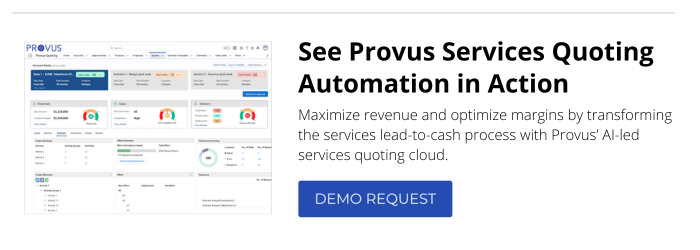


Services Quoting for Professional Services

Services Quoting for Consulting Services

Services Quoting for Asset-Based Services
For service organizations, it’s crucial to eliminate margin leakage and streamline processes for real-time operational clarity.
Today, we’re launching Provus CPQ Express: a powerful, lightweight quoting tool for services teams that are ready to move past founder-led sales.
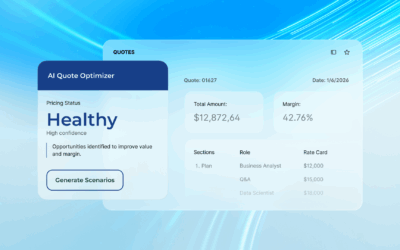
Learn how agentic AI is transforming services pricing, productivity, and operating models, and how organizations can prepare for value-based outcomes.