
Why enterprise CPQ is the wrong fit for mid-market services teams
Mid-market services teams fail with enterprise CPQ for one reason: the platform assumes quoting logic, deal structure, and operating model that don’t exist at their scale.

Are you about to send over a first proposal? You’ll know it’s unusual to get acceptance straightaway. It’s more usual to get a reply along the lines of, ‘Hey, can you make a few changes?’
Maybe other stakeholders are now involved, with different priorities. That can be a good sign, perhaps signaling those in authority are looking at signing off the deal. Or maybe your prospect is gathering a selection of proposals to analyze and compare side-by-side.
Whatever the situation, you’re dealing with unknown variables when trying to model different scenarios. Static spreadsheet templates and frameworks only go so far to mitigate this, especially when trying to identify the best margin-positive pricing scenarios.
That lack of visibility is compounded when your initial spreadsheet gets shared, duplicated, edited. Probably many times, when you consider that 93% of B2B buying groups have two or more people, with 71% of those groups comprising four or more. Pretty soon, there’s no more single source of truth to refer back to.
To keep momentum high, the ideal next step is to quickly scope and offer estimates that satisfy your prospects and the related governance and compliance departments. However, many professional services organizations are still experiencing challenges in their lead-to-cash selling process.
The more information the prospect has, the easier and faster they can make up their mind. Of course, this means any change to a scenario can have big impacts on margins. There are also multiple obstacles to overcome on the path to approval. These include:
It’s difficult to model accurate what-if scenarios when you’re factoring in different pricing levers. Especially if you’re using a dynamic strategy such as cost-plus pricing, and you’re trying to forecast costs likely to fluctuate over longer periods.
Complex deals with long cycles usually involve multiple rounds of reviews. With more buyers involved, it soon becomes impossible to keep track of document changes, especially when using unstructured data for margin analysis. The risk of Garbage In, Garbage Out is a constant risk, whether from invalid data or human input errors.
The more changes made, the harder it is to compare multiple spreadsheets side by side. The sales process slows down, conditions and costs may change, and carefully calculated margins can become outdated.
When prospects ask for add-ons or request a discount, slow responses and iterations can lead to frustration at the delays. Naturally, this makes it harder to build business relationships, and to arrive at a satisfactory price for all parties involved.
Valuable time is lost without a centralized or synchronized way of tracking approvals. Instead sales have to keep going to the deal desk every time a new scenario is submitted. It becomes a reactive approach, leading to delays when scenarios are finally reviewed and need further modification.
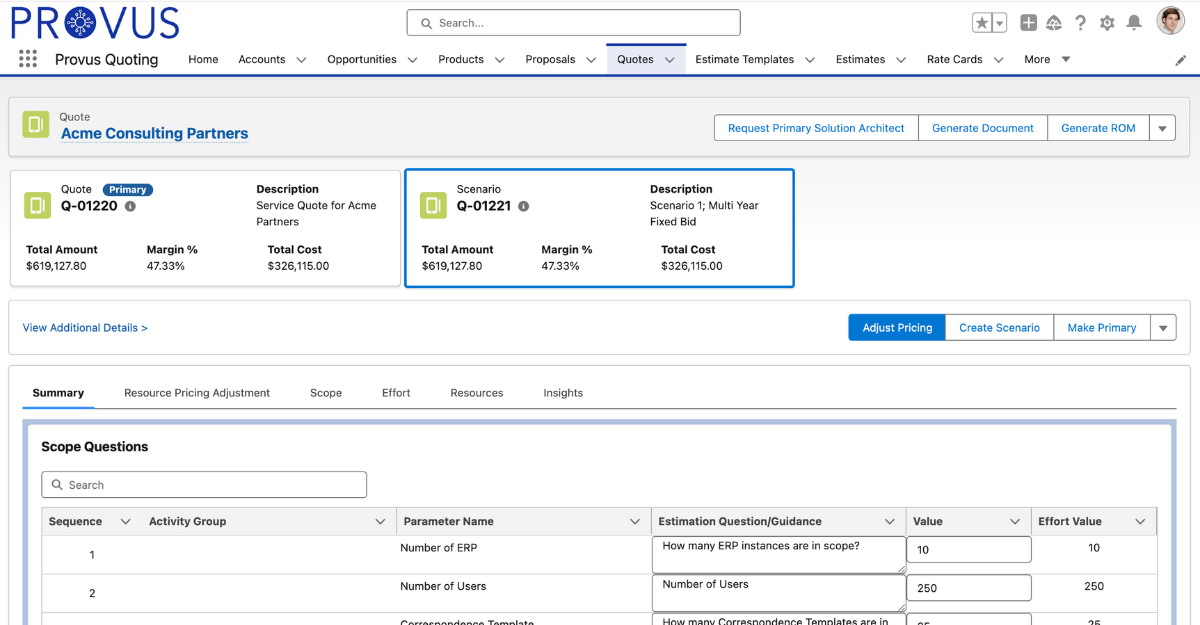
These kinds of challenges will be instantly recognizable to sales and operations managers, directors and VPs. That’s why so many are choosing Provus for quantitative scenario modeling. The platform is built for professional service organizations, with multiple features and tools to take sales processes way beyond static or fixed product-based scenarios.
You can scope, cost and optimize – and then produce a scenario in a single click. This scalable standardization comes with the added bonus – helping sales teams comply with organizational guidelines. For example, when scenarios have to adhere to tender offer guidelines, or align with the prospect’s procurement process.
There’s no need to switch between spreadsheets and screens with Provus. One dynamic source provides accurate data that’s easily comparable. It’s a faster and more fluid way of working, and gives the prospect a better experience when they want to make quick comparisons.
Agility and flexibility are at the heart of modern professional services. With Provus, quoting can be as fast as is necessary to compete for and close deals. You can model a fixed price scenario against a more flexible time and materials contract. Explore how different scenarios can deliver within scope while staying as profitable as possible. Model different schedules to view potential ROI over longer-term contracts. Find out what happens when a different pricing strategy is applied to a changing resource mix.
Say goodbye to back-and-forth bottlenecks that can arise when working to a single scenario. Instead, model multiple scenarios based on conversations, requests, and other insights you’ve gathered. You get a powerful way to ‘show, not tell’ the benefits or drawbacks of different scenarios.
Teams can quickly decide a best-fit scenario and use it as the base for the primary quote. Any adjustments can then be quickly compared to secondary scenarios, to evaluate and understand impact of changes. Identifying the primary quote also means it can roll-up and populate forecast reports across the business. These aggregated insights allow teams to gain visibility and understanding of the steps involved. The result – more knowledge-sharing and greater collaboration, and less siloed information that’s often lost when team members move on.
Scenario modeling in Provus delivers impact across three business-critical areas:
You can’t delete uncertainty from the process. So the next best thing is being able to prepare for it. Quantitative scenario modeling with Provus allows you to model as many scenarios as you need, from what-if, to best case, and worst case. So that you can analyze potential and actual impacts on margins with confidence and speed. And then reduce cycle times, and negotiate profitable winning deals.
To explore how to transform lead-to-cash for professional services, book a demo today.


Services Quoting for Professional Services

Services Quoting for Consulting Services

Services Quoting for Asset-Based Services
Mid-market services teams fail with enterprise CPQ for one reason: the platform assumes quoting logic, deal structure, and operating model that don’t exist at their scale.

30-year services veteran Paul Jakaitis explains the data, taxonomy, and governance work that makes CPQ and AI worth the investment.

AI is restructuring how services companies operate, price, and grow. Provus CEO Stawan Kadepurkar breaks down the three fronts reshaping the services industry.