
Move beyond founder-led sales with Provus CPQ Express
Today, we’re launching Provus CPQ Express: a powerful, lightweight quoting tool for services teams that are ready to move past founder-led sales.

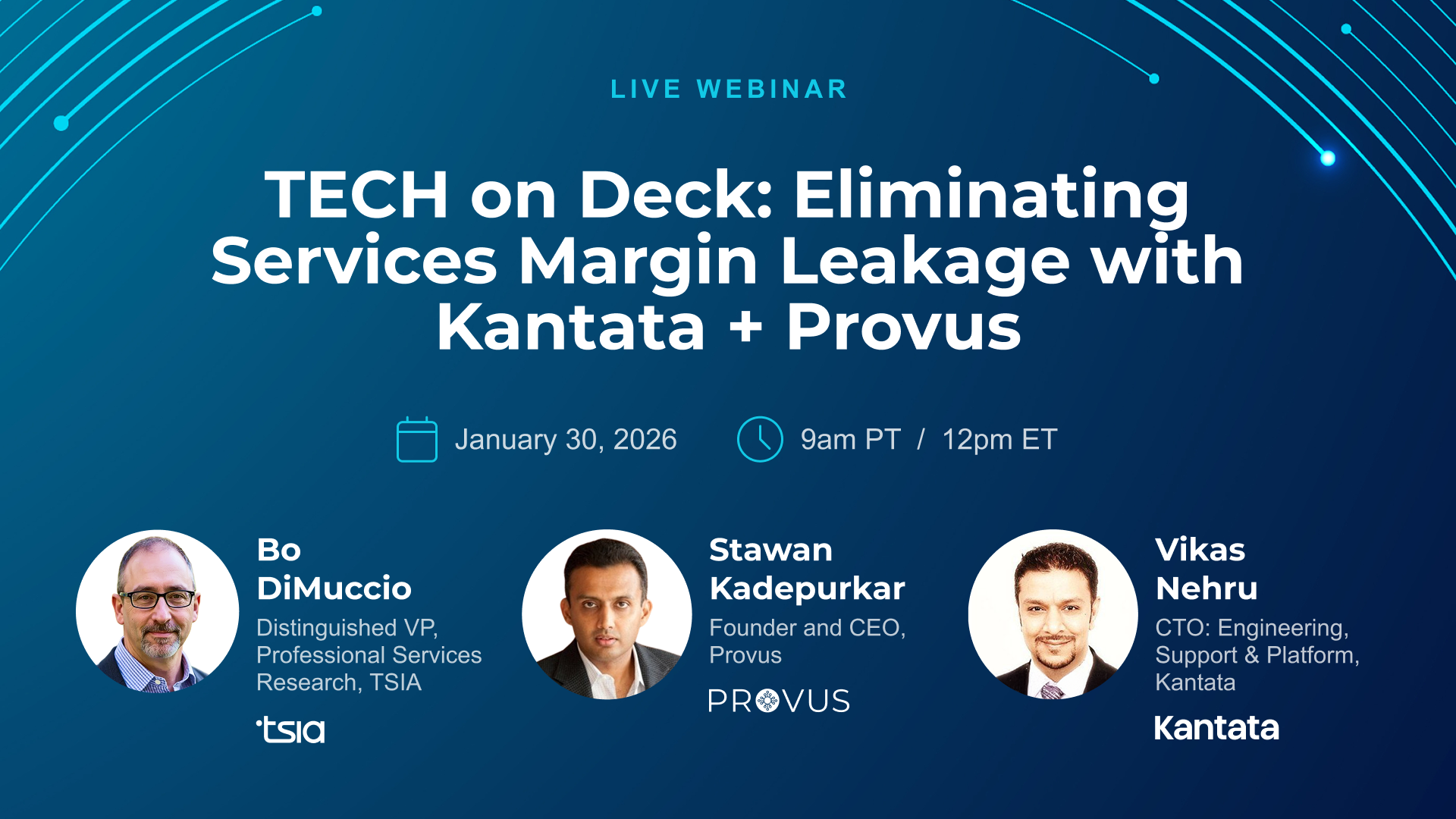
For service organizations, it’s crucial to eliminate margin leakage and streamline processes for real-time operational clarity.
In a recent TSIA TECH on Deck webinar, Bo Di Muccio (Distinguished VP, Professional Services Research, TSIA) sat down with Stawan Kadepurkar (Co-Founder & CEO, Provus) and Vikas Nehru (Chief Technology Officer, Kantata) to discuss how Kantata and Provus combine to find and fix hidden margin leaks, boost delivery with AI-powered quoting to enhance downstream delivery performance, and enable practical workflows throughout project lifecycles.
Kantata is a resource management and forecasting platform for the professional services lifecycle. Provus is an agentic AI-powered services quoting platform that enables teams to automatically optimize pricing, generate quotes, and reduce risk.
Get the webinar breakdown below, and watch the replay any time here.
Margin leaks are challenges across organizations of all sizes. It starts after the deal is inked and compounds quietly throughout the delivery. Today, more customers expect a values-based pricing approach and clear ROI over time-and-material pricing. But organizations’ disconnected systems impact delivery from early on in the engagement—sometimes even before signing.
According to Kadepurkar, service organizations’ biggest pain points are:
“Margin is under pressure [due to] changing customer expectations around value, outcomes, fixed bids, and making sure you deliver value,” Nehru says. “When you look at the reality of projects, they’re very unpredictable. Things can go wrong. Things can change. Expectations change.”
Still, customers have access to a wealth of PSA data, and they want to leverage it in pitches. As a result, winning projects are backed by credibility.
“Because I’ve delivered these projects so many times, I know up front I’m arming the sales team with all the gotchas, all the nuances, so they make sure to craft a profitable project up front as opposed to dealing with it downstream,” he says.
To effectively leverage PSA data, service organizations must first recognize and remedy the signals of disconnected systems:
Once you’ve surfaced these signals of disconnection, the next question is how to use your data and AI to actually close those gaps—rather than just layering more tools on top.
In addition to expecting values-based pricing, customers want to know how service organizations will implement AI to add value.
To provide credible value to your organization, AI must:
Provus and Kantata bring this kind of contextual, data-driven AI into a connected quote-to-delivery workflow.
Provus and Kantata work together to eliminate margin leakage for your organization, balancing right resources, costs, and project timelines while projecting trade-offs up-front. With this information, customers and service teams can make more informed decisions.
Knowing potential project risks prevents your sales team from overselling. It also prepares the delivery team for challenges before they arise, giving them upfront visibility so they can plan ahead.
Finally, Provus and Kantata can help centralize and align details from past projects, such as:
All of this comes together most clearly in how your quote-to-delivery process changes.
Combining Provus and Kantata creates a powerful transformation in your quote to delivery process.
According to Kadepurkar, delivery gets up-front high visibility of quotes in the pipeline—and a sense of what will win. This enables them to start planning for delivery well in advance. Additionally, the sales team is no longer worried about surprises in delivery or customer dissatisfaction.
Nehru says, “[Kantata’s] algorithms are designed to create that real-life trade-off balance between the right resources, the right costs, the right timeline. And we’re able to project this up front in the cycle so […] the choices are available to the customer, and together, the services team and the customer can make that trade-off effectively.”
“Right from the start, even before a deal is won, the customer is aware of the risks involved,” adds Kadepurkar. “Real-life things happen, […] but everybody is prepared for it.”
Stepping back from individual projects, the bigger takeaway is that margin leakage has to be managed across the entire lifecycle.
For companies and customers to effectively align on value, it’s crucial for sales and delivery teams to interlock. According to Di Muccio, few organizations can truly say they have a deep, high-quality interlock in their workflows, processes, systems, tools, sales, and services. As Di Muccio summarizes, margin leakage isn’t confined to a single department.
“Margin leakage is not a sales or a pricing problem, or a services or delivery problem,” he says. “It’s a lifecycle problem.”
Watch the webinar replay here.


Services Quoting for Professional Services

Services Quoting for Consulting Services

Services Quoting for Asset-Based Services
Today, we’re launching Provus CPQ Express: a powerful, lightweight quoting tool for services teams that are ready to move past founder-led sales.
Learn how agentic AI is transforming services pricing, productivity, and operating models, and how organizations can prepare for value-based outcomes.
As services organizations grow, quoting becomes harder to manage. Deals involve complex requirements, regional pricing, margin pressure, and constant market change. What once lived in spreadsheets, emails, and one off tools becomes difficult to scale and even harder to trust.