
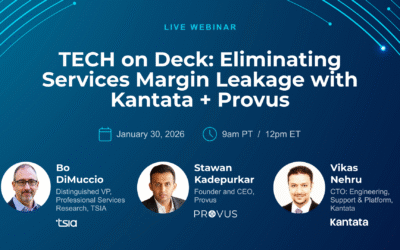
How Kantata & Provus Eliminate Services Margin Leakage (TSIA TECH on Deck)
For service organizations, it’s crucial to eliminate margin leakage and streamline processes for real-time operational clarity.


When we talk about KPIs, there is nothing better than conversion. Improving the bottom line and making profits is the ultimate aim of any business. However, the road to profit is a tough one, especially for professional service organizations.
Techniques like optimizing the sales cycle, reducing errors, and improving customer relationships, to name a few, are key pillars in the sales process that will get the profit rolling right into your court.
A detailed insight into each of these pillars will help your business optimize margins in a more nuanced and systematic manner.
Approaching the right target, giving them the right deal, solving their problems quickly and helping them implement in a short turnaround time is what MOST prospects and customers are looking for. A faster selling cycle means time to generate more leads and thereby, improve profits.
You can enhance your selling cycle by clearly defining your target audience for better quality leads and eliminating cold leads.
Most companies waste time by not optimizing their lead generation process which affects the common messaging. Connecting marketing qualified leads with sales qualified leads will help give a clearer picture.
Digital collaboration tools also work well in improving communication among project participants which further speeds up the sales process.
Read more: How to stop revenue leakage during the quoting process?
While following the enquire, configure, quote, and make process is the go-to technique, most sales professionals race into creating proposals and quotations that work for their respective prospects based on previous data or instinct. These processes are usually executed manually and can lead to errors.
Automation can rectify these errors.
Automating outputs like rate optimization, beta models, quotations, and beyond has a significant impact on reducing the time taken for approval. With automation, the process becomes more data-reliant and follows a workflow that can also be tracked by sales managers and the leadership.
For instance, installing a business intelligence tool allows managers to gain insights into the end-to-end cycle of a deal, right from quotation to development, and delivery. This enables them to learn from the experience and fine-tune their existing methodologies to be error=free.
Right pricing is important for every business. Even a 1% increase in your direct sales can shoot up your YOY revenue significantly. However, it may also turn your buyers away so you have to even it out.
Pricing relies on different factors, the market demand and scenario, your total cost, your average cost, and economic trends to name a few.
How to set your value prices?
Read more: How to drive sales acceleration using services quoting?
An efficient quoting process can skyrocket your customer experience.
For instance, if customers receive a quotation in a structured format with all the breakdowns and no hidden costs it makes it easier for them during the decision-making process. They know exactly where their money is going which helps in building a solid customer experience.
In order to streamline quoting processes, it is important for businesses to understand what their customer needs. Sales professionals can spend time understanding their requirements and then offering a solution that would fit their situation and budget.
Automation again can improve your business’ quoting process as well. It ensures that the information and the final quote are timely sent to higher authorities and then to the prospect, thus speeding the approval process.
The automated quotation process also enhances workflow, time of delivery, and transparency which further amplifies customer satisfaction.
Accurate pricing of your product/service is key. You can get the right number by considering your variable costs and fixed costs. Your selling price must be higher than your fixed and variable costs combined to not only break even but even bring in profits.
However, if you set the price too high, you might lose your buyers.
The best way to do it is to set the value of your service/solution before rolling out the cost.
The value should not be confused with the cost. In other words, the value of your offering is the benefit you give your customer often in comparison to your alternatives. If your service helps your clients save thousands of dollars, in exchange for a fee of a couple of hundred dollars, then you are selling value.
Read more: How to drive revenue maximization in the sales process?
Accurate pricing = (Value of your services – value of the alternative services) + cost price of your competitor
For instance:
If your service costs $150 dollars but offers a value of $1500 for your customer while your competitor offers the same price but the value deteriorates to $1000, then your accurate pricing should be:
($1500 – $1000) + $150 = $650
Your accurate price should be $650 for the benefits it offers your customers.
Automating your sales process is important to help streamline your quoting process, approval process, workflows and much more to achieve your margins. While a lot depends on experience, automating your process gives your sales team the room to generate more leads, be more accountable and eventually boost your bottom line.
Provus services CPQ platform paves the way for margin optimization through intelligent AI-led “What-if” scenarios and a rule-based configurable engine for professional service organizations.


Services Quoting for Professional Services

Services Quoting for Consulting Services

Services Quoting for Asset-Based Services
For service organizations, it’s crucial to eliminate margin leakage and streamline processes for real-time operational clarity.

Today, we’re launching Provus CPQ Express: a powerful, lightweight quoting tool for services teams that are ready to move past founder-led sales.
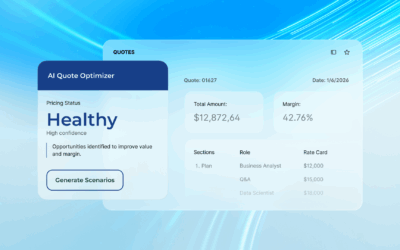
Learn how agentic AI is transforming services pricing, productivity, and operating models, and how organizations can prepare for value-based outcomes.