
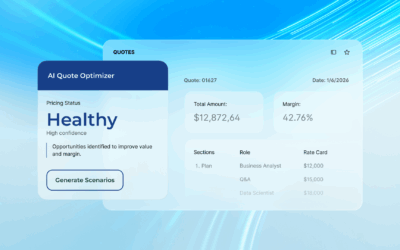
Services Pricing Is Evolving For an Agentic World. Here’s How.
Learn how agentic AI is transforming services pricing, productivity, and operating models, and how organizations can prepare for value-based outcomes.


Today companies, especially in the services sector, have the choice between traditional Excel or spreadsheet-based solutions and novel services quoting technology to expedite their sales quoting processes.
In this article, we cover a detailed breakdown of Excel Spreadsheets vs services quoting software and how each solution contributes to the quoting process.
Most professional services organizations, even today, rely on traditional spreadsheets to manage their quotes, calculate the total budgets, and much more. They use Excel Spreadsheets in creating essential employee-resource schedules and executing basic accounting where salespeople can enter expenditures and deposits in designated rows and use the data to create business reports. Companies also use them to track product sales, store customer data, and also calculate ROI.
As popular as it may be, spreadsheets are prone to error and can be ineffective when executing long-drawn sales quotations. What’s worse, as the complexity of data increases, Excel-based sales quoting becomes slow.
Services quoting software is changing how teams approach sales. Provus’ Services Quoting Cloud is an AI-led platform that transforms the way enterprises quote for their services with a smarter solution for estimates, pricing, and quotes. It automates calculation, quotation, contract management, and much more, making the entire process clearer and more accurate.
Interestingly, automation helps boost sales productivity by 14.5% and close more deals, indicating that quotation software is a better counterpart in the Excel spreadsheet vs. services quoting battle.
Using services quoting software helps:
Excel is an excellent tracking tool, but it falls behind the mark regarding quotes. Here are a few drawbacks of using Excel for quoting in the Excel vs services quoting cloud debate.
There is no collaborative structure to an Excel sheet. Yes, multiple people can access the spreadsheets, but only one person usually works on creating it from scratch, which makes it rather limiting for other stakeholders to track and assess the changes and updates.
Permissions and access controls are tricky to manage when it comes to Excel. Unlike many automated tools, Excel cannot bar user entry and does not comprise administrative power that can grant this access to individual users.
An excel workbook cannot sustain privacy policies. Sharing the Excel spreadsheets from team to team can lead to discrepancies in data and its authenticity that can impact business decisions. However, it is impossible to check who made those changes and who has access to the sheet.
Using an Excel spreadsheet, you cannot track changes and edits. Changing data in multiple rows without finding the anomaly can lead to huge losses and data breaches.
Just like a typical workbook, the Excel workbook entails a manual process. Users have to double-check every entry and re-enter data if incorrect manually. This is a time-consuming process that delays the decision-making process, which is a disadvantage for growing businesses.
There are dozens of spreadsheets involved while working on Excel. These multiple sheets need to be managed manually, which can be redundant and lead to cash drain and inaccuracy in data. Excel, unfortunately, still does not comprise multiple aspects like risk, data subjects, processes, suppliers, processes, and assets that can present clear and accurate data.
Excel, when calculating bigger numbers, tends to slow it down. It also does not allow multiple stakeholders, which adds to the delayed approval cycle. The culmination of the two leads to decelerated performance and delayed results.
Since excel does not have scope for tracking, it does not leave any room for a clear audit trail. The lack of seamlessness leads to unmarked edits and no accountability for any changes that can cause cost and resource-intensive mistakes.
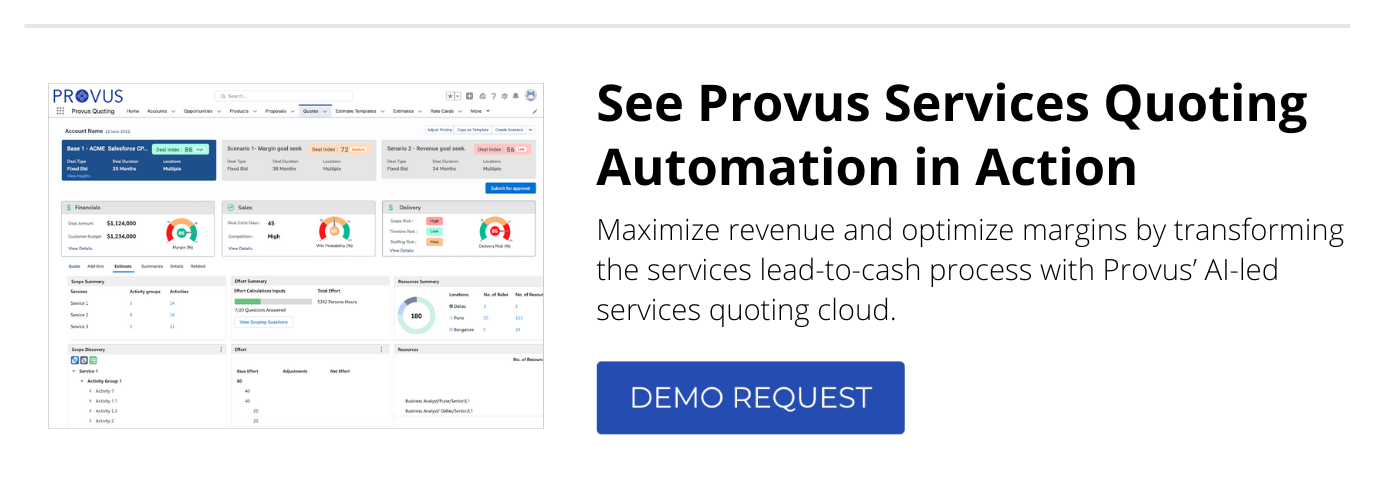
With top-notch services quoting cloud, companies can leverage predictive technology like AI and ML to make their selling ‘smart.’
They automate redundant tasks while upping the template library to ensure that the contractual obligations are met accurately. AI-based selling by Provus services CPQ platform further reduces time and increases efficiency, transparency, and reliability while ensuring that all SOWs are met.
Services quoting cloud is also changing the status quo of the quotation process being a siloed job. Automated services quoting cloud ensures that stakeholders, including sales, pre-sales, HR, and finance team members work on their respective tasks but also keep an eye on the overall picture, thereby negating the multiple feedback loop.
The collaborative structure of the solution also adapts to changing business scenarios and sends updates to respective members to make informed business decisions. This way, there is no time wasted on approvals, and the contract complies with all regulated policies.
Each document should have a detailed SOW guideline that ensures fairness for the service provider and the customer. Provus services cloud quoting software generates precise SOW relevant to the project and ensures no money is left on the table. This way it helps in stopping revenue leakage in the quoting process.
Intuitive services quoting cloud software, along with guided selling, help break down long approval processes to enable faster conversions and closures.
Businesses are riddled with complicated processes that include legal compliances, confidential numbers, demographics like geographies, and other data, making it easier for risks to hide between the lines. The solution scans through the content and, with analysis, offers an intuitive risk scoring that recommends measures to minimize risk.
Provus’ Services Quoting Cloud helps create different scenarios and helps the team analyze different contractual conditions to quote better. Scenario analysis helps reduce risks and opens up opportunities to access capital pathways while preparing for the best and worst-case scenarios.
The services quoting cloud can be integrated with third-party business sources such as CRMs, ERP, HCM, and so forth, to enable the flow of information across the tools to maintain data accuracy and timeliness. The result is faster and more accurate services quoting.
While Excel has been around for more than 30 years for data operations and formatting, it takes a seat back when it comes to quoting. The new and improved services quoting cloud solutions like Provus are doing a much better job at securing quotation management, contractual management, and closing deals.
Businesses choosing the services cloud quoting software compared to Excel for services quoting are more likely to experience faster sales cycles and approval processes.
To know more about how Provus can expedite your services quoting process, book your free demo.


Services Quoting for Professional Services

Services Quoting for Consulting Services

Services Quoting for Asset-Based Services
Learn how agentic AI is transforming services pricing, productivity, and operating models, and how organizations can prepare for value-based outcomes.

As services organizations grow, quoting becomes harder to manage. Deals involve complex requirements, regional pricing, margin pressure, and constant market change. What once lived in spreadsheets, emails, and one off tools becomes difficult to scale and even harder to trust.
Integrated solution connects sales estimation to project execution, empowering services organizations to deliver faster, with greater accuracy and margin control